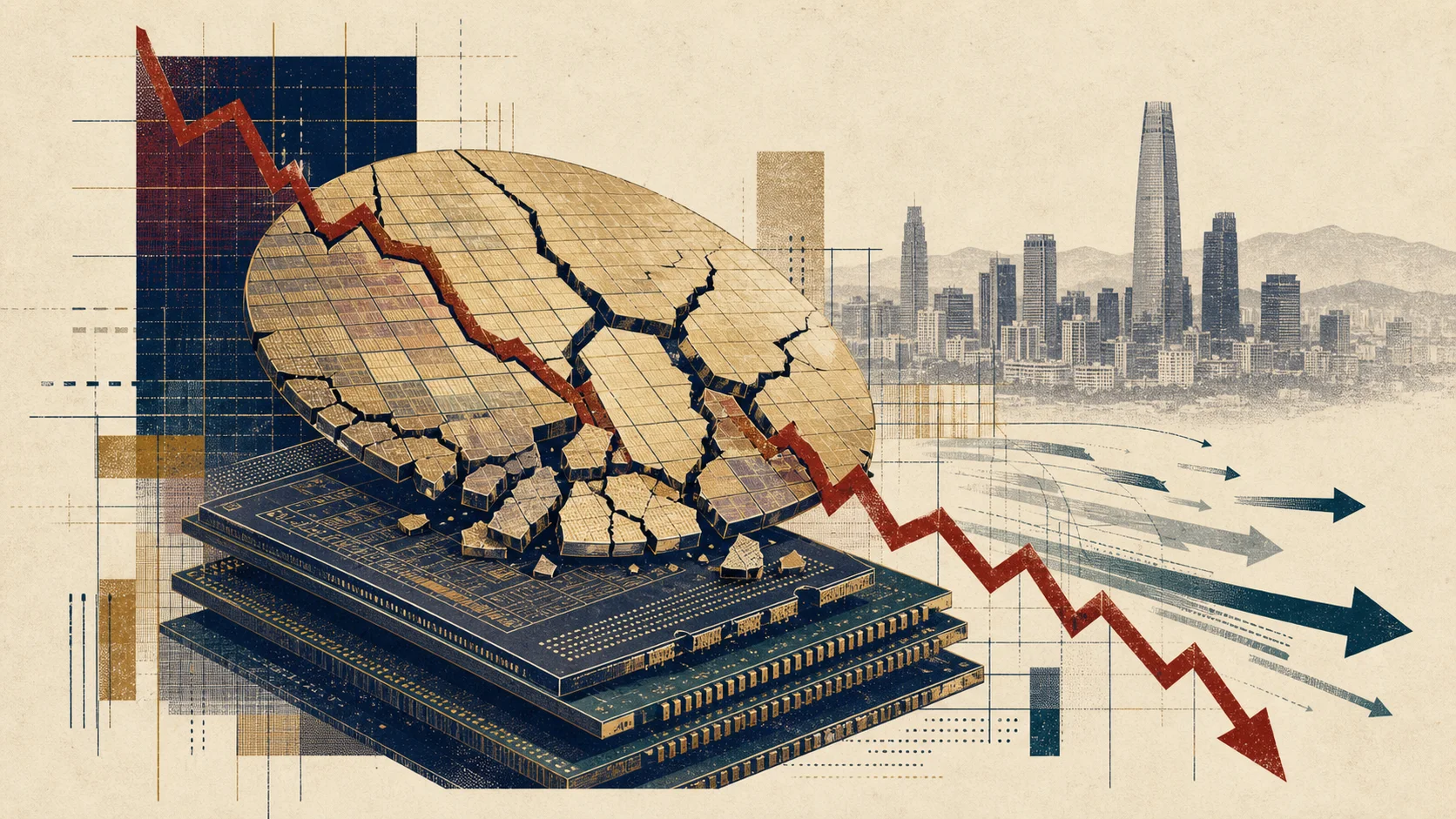
KOSPI closed at 5,663.24 on July 29, down 5.98%. At its low it was off 12.63%, enough to trigger a market-wide circuit breaker for the second day running. The index has lost 16.17% in two sessions. KOSDAQ fell 6.12%, SK Hynix 9.61% and Samsung Electronics 5.23%.
That same morning, Hynix reported a quarterly operating margin above 76%.
What Investors Counted After the Record
The preliminary results filed with the US SEC showed KRW 79.32 trillion of revenue and KRW 60.54 trillion of operating profit, up 256.8% and 557.2% from a year earlier. The numbers were enormous and still missed: LSEG consensus called for KRW 84 trillion of revenue and KRW 64 trillion of operating profit. Hynix mentioned delayed shipments of some advanced products; analysts tied part of the shortfall to slower HBM4 revenue recognition.
The capital plan now matters as much as the profit. Hynix expects to spend in the high-KRW-40-trillion range this year, up from KRW 30.2 trillion in 2025, and has completed roughly ten supply agreements that typically run for five years. Customers continue to ask for more memory, and contracts make that expansion easier to finance. They also leave investors asking what has been fixed: volume alone, or some of the future pricing upside as well.
Management did not provide a detailed cash-return plan on the call and said more would come later this year. During an ordinary quarter, that delay might pass quietly. Beside a 76% operating margin, it becomes harder to ignore. Investors want to know where expansion ends and distribution begins.
The same distinction was visible on Wall Street overnight. SPY rose 0.24%, VIX fell 2.46% and Nvidia gained 0.25%. Micron dropped 8.85% and SMH lost 3.45%. Selling was heaviest around memory, equipment and businesses committing the most capital, rather than across the whole AI complex.
Korea Tried to Rebound Before It Broke Again
The earnings report did not arrive in a calm market. KOSPI had fallen 10.84% on Tuesday and Hynix 14.65%. On Wednesday morning, however, KOSPI opened 1.09% higher and reached 6,228.52. Hynix rose from KRW 1.55 million to KRW 1.619 million. The rebound then failed. Hynix fell as much as 19.61%, and KOSPI recovered 7.61% from its low but still finished deep in the red.
Hynix and Samsung together represent more than half of KOSPI’s market capitalization, so a reassessment of the two memory companies lands directly in the index. Leveraged single-stock ETFs and borrowed retail exposure may have added force. Reuters reported forced closures of some losing positions, and a higher minimum deposit for those products takes effect on July 31. There is no public breakdown showing how much of Wednesday’s fall came from leverage, so it remains a possible amplifier, not a settled explanation.
I am not ready to call this report the top of the memory cycle. HBM4 revenue may simply have slipped into a later quarter, and the long contracts may preserve pricing power while securing volume. The price action still says something uncomfortable: current profit is abundant; evidence that the next expansion will preserve returns is not. Samsung reports full results on July 30. Another record print followed by weak demand for the shares would deepen peak-cycle concern, while continued deleveraging would remain part of the story.
Sources: Korea Exchange (KRX) closing prices and turnover for July 29, 2026; SK Hynix’s July 29, 2026 Form 6-K preliminary results filed with the US SEC; Reuters reporting on the earnings call, consensus estimates, capital spending, long-term supply agreements, cash and Korea’s leveraged products; and AP reporting on Asian and US markets on July 29. US market data are from the July 28 close; Korean data are from the July 29 close. The discussion of leverage, returns on expansion and contract pricing represents research judgment rather than a single cause established by the company or exchange. Companies, securities and indices are discussed only as research subjects and do not represent a KSINQ recommendation to buy, sell or hold. Past price moves do not predict future results. This article presents personal research and opinion for informational purposes only and does not constitute investment advice.