Korea Was the Strong Spot
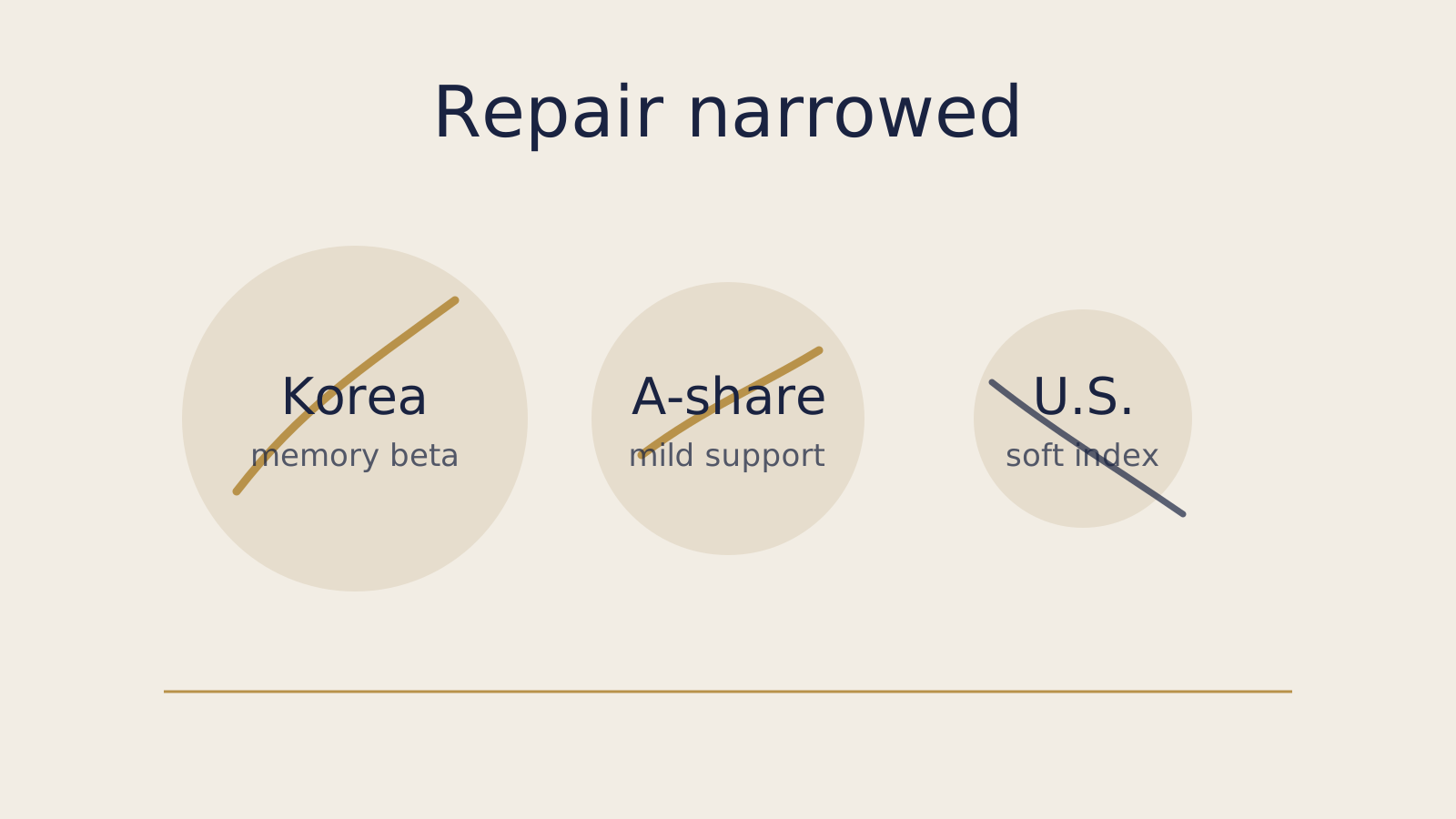
On April 20, cross-market repair had not disappeared. It had narrowed. The strongest area was Korea’s memory chain: KOSPI +2.72%, SK hynix +4.97%, Samsung Electronics +2.10%. Japan had local strength too, with Nikkei 225 +0.89% and Tokyo Electron +3.46%, but Toyota fell 3.24%, so the Japanese tape was uneven.
A-share broad indices rose mildly: CSI 300 +0.61%, CSI 500 +0.92%, CSI 1000 +0.61%. U.S. indices weakened: SPY -0.20%, QQQ -0.32%, NVDA +0.19%, TSM -1.15%, AMD -1.24%. VIX rose 7.95% to 18.87 (Yahoo Finance daily price data, 2026-04-20).
The useful combination was this: Korea memory stayed strong while U.S. indices and parts of core tech softened. The repair was still there, but it was becoming more concentrated.
Why Memory Could Carry the Handoff
Memory stocks have elasticity from two directions. First, they are high-beta links inside the AI hardware chain, where the pricing cycle and HBM narrative can amplify equity moves. Second, the market had already been separating “compute core” from “supply-chain links,” and memory is one of the constraints investors can still trade during a repair window.
But concentration also means fragility. On April 20, U.S. indices did not confirm, VIX rebounded, and TSM and AMD fell. Capital was not buying tech broadly; it was reaching for one of the more elastic links.
That is different from April 8’s broad repair. April 8 had A-shares, U.S. equities, and volatility all aligned. April 20 had Korea memory standing out while the U.S. and volatility kept reservations.
The Other Side
The constructive read is that the handoff was still alive.
Korea memory was not a single-stock move. SK hynix and Samsung rose together, and KOSPI gained 2.72%. That is broader than one name.
A-share broad indices were still positive. The gains were modest, but all three broad indices rose. Mainland China was not dragged down by the U.S. tape.
The U.S. decline was small. SPY -0.20% and QQQ -0.32% are not destructive moves; they can be read as digestion.
Those points hold. Structurally, the repair had moved from wide to narrow.
Closing
April 20 was not risk repair switching off. It was risk repair narrowing. Korea memory carried the handoff, A-share broad indices followed mildly, but U.S. indices softened and VIX rebounded.
When repair depends more on a few high-beta links, it can continue, but its margin for error falls. The next question was not how much SK hynix could rise on one day. It was whether more assets outside memory could reconnect.
What to Watch
The following is an observation framework, not a trading signal.
- Whether Korea memory strength broadens into more semiconductor assets. A repair led only by SK hynix / Samsung stays narrow.
- Whether the VIX rebound persists. Rising volatility discounts the quality of risk repair.
- Whether A-share broad indices stay positive. That decides whether the repair still has regional dispersion.
Data sources: Korean benchmarks (KOSPI, KOSDAQ, plus Korean memory names), Japanese benchmarks (Nikkei 225, plus major Japanese tech and auto names), A-share broad indices (CSI 300 / 500 / 1000), and US large-caps and semiconductors (SPY, QQQ, NVDA, TSM, AMD, VIX) price data from the Yahoo Finance daily price data (Yahoo Finance daily prices and public A-share index quotes), trading day 2026-04-20, queried 2026-05-26.