Stable Indices, Split Chain
At the index level, April 16 looked like continued stabilization. A-share broad indices rose: CSI 300 +1.10%, CSI 500 +1.69%, CSI 1000 +1.56%. The U.S. was also firm: SPY +0.25%, QQQ +0.48%. VIX slipped 1.27% to 17.94.
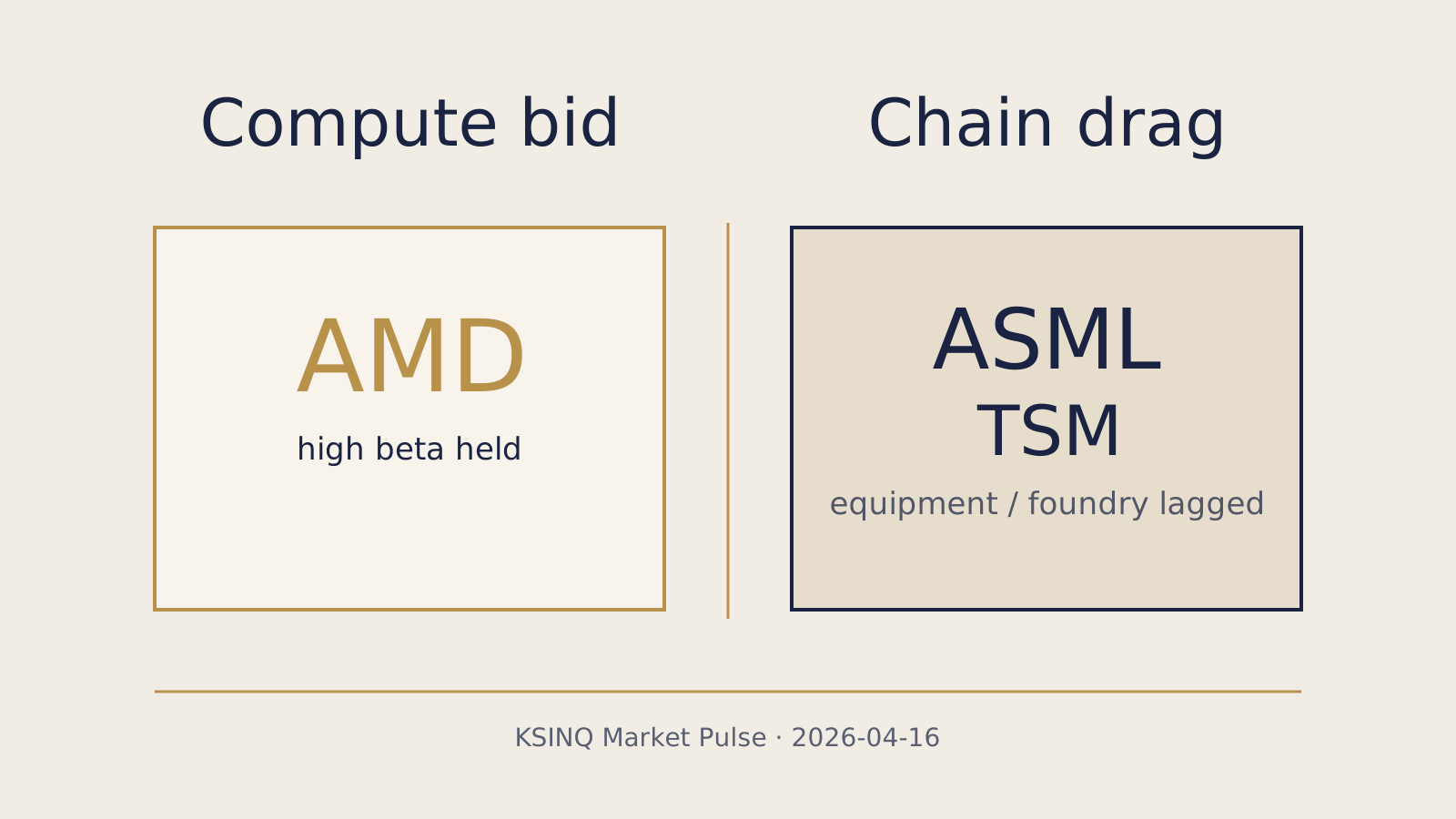
Inside semiconductors, the story was completely different. AMD rose 7.80%, while ASML fell 4.79%, TSM fell 3.13%, and NVDA slipped 0.26% (Yahoo Finance daily price data, 2026-04-16). Japan and Korea leaned weak too: Nikkei 225 -1.75%, Tokyo Electron -3.95%, KOSPI -0.55%, SK hynix -2.34%.
Index stability hid the more important change: the market was no longer buying “semiconductors” as one block. It was pulling the chain apart.
Why the Split Matters
The semiconductor trade had carried an implicit assumption: AI demand was strong enough to lift compute, memory, equipment, and foundry together. April 16 loosened that assumption.
AMD’s jump says capital was still willing to chase compute beta. But ASML and TSM falling together says equipment and foundry were not being repriced in sync. NVDA staying almost flat also meant the core AI leader did not give a strong confirmation.
This kind of split often carries more information than index moves. When indices hold up, the market can still be selective. When indices break, everything gets sold together. April 16 was a selective market: risk appetite was not broken, but the bid was pickier. It accepted compute elasticity without automatically buying the whole supply chain.
The Other Side
There is a simpler explanation: one-day rotation.
AMD’s move may be single-name beta. A 7.80% gain is strong, but it does not prove equipment and foundry have been systematically rejected.
ASML and TSM may only have given back prior strength. On April 8, ASML rose 8.77% and TSM 5.96%; some pullback afterward is not surprising.
A-share broad repair continued. CSI 300, CSI 500, and CSI 1000 all rose, so mainland risk appetite was not dragged down by the offshore semi split.
Those points stand. Structurally, though, April 16 says the semi trade had moved from buying the theme to selecting the link.
Closing
The headline for the day was not “tech kept rising.” It was “tech started splitting.” AMD was strong, ASML and TSM were weak, NVDA did not confirm, and A-share broad indices kept repairing.
When a theme matures, the most important signal is often not whether the index rises. It is which assets inside the same story can still rise and which start to lag. On April 16, the laggards were not peripheral. They were equipment and foundry.
What to Watch
The following is an observation framework, not a trading signal.
- Whether ASML / TSM keep lagging AMD / NVDA. That decides whether the split is noise or a chain-level pricing change.
- Whether A-share repair continues independently. If broad indices keep rising, mainland risk appetite is trading more on its own rhythm.
- Whether VIX stays low. Dispersion in a low-volatility setting is more likely to be selective pricing.
Data sources: US semiconductors and large-caps (AMD, ASML, TSM, NVDA, MRVL, CRWV, SPY, QQQ, VIX), A-share broad indices (CSI 300 / 500 / 1000), and Asian benchmarks (Nikkei 225, KOSPI, plus Japanese and Korean semiconductor names) price data from the Yahoo Finance daily price data (Yahoo Finance daily prices and public A-share index quotes), trading day 2026-04-16, queried 2026-05-26.