The Repair Did Not Accelerate
April 8 was the day cross-market repair broadened. April 9 was the day it cooled. A-share broad indices pulled back: CSI 300 -0.64%, CSI 500 -0.59%, CSI 1000 -0.43%. The prior day’s mid/small-cap beta did not extend directly.
The U.S. still rose, but mildly: SPY +0.58%, QQQ +0.68%, NVDA +1.01%, ASML +1.94%, TSM -0.11%. VIX fell again, from 21.04 to 19.49, down 7.37% on the day. Japan and Korea still had local follow-through: Nikkei 225 +1.84%, Tokyo Electron +4.38%; KOSPI +1.40%, SK hynix +2.91%, Samsung Electronics +0.98% (Yahoo Finance daily price data, 2026-04-09).
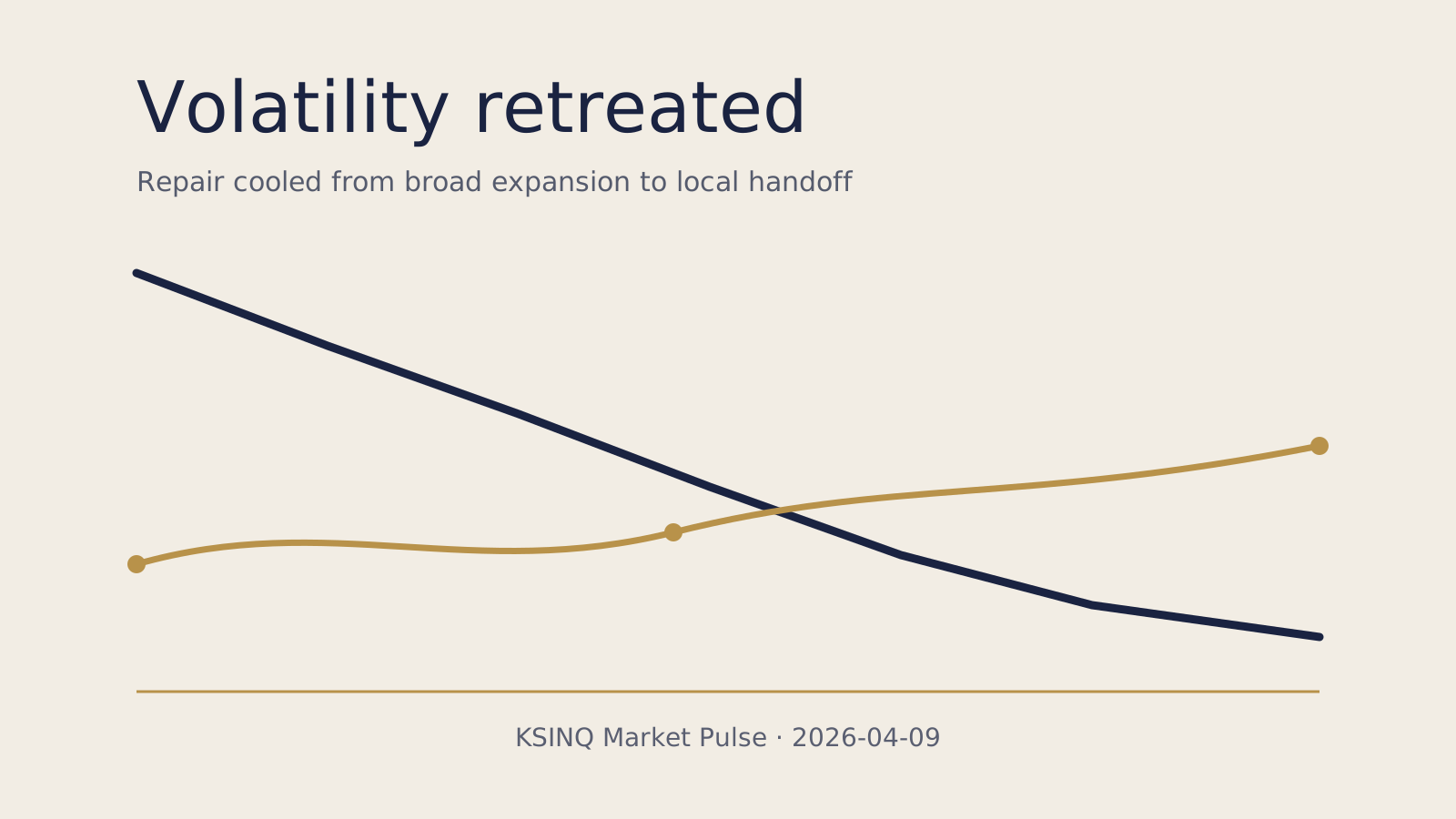
This was not risk acceleration. It was volatility retreating while asset performance started to segment again.
Cooling Carried the Information
If we only look at U.S., Japan, and Korea, April 9 was still a positive day. But compared with April 8, the signal was weaker.
First, A-shares did not extend the strong repair. CSI 500 had risen 4.94% and CSI 1000 4.60% the prior day. A small pullback the next day says the mainland tape was digesting the move rather than pushing continuously.
Second, the more important U.S. signal was volatility, not index gain. VIX falling to 19.49 meant the market was no longer buying stocks and protection at the same time as it did on April 7. Risk pricing was calmer, but the equity move itself did not become an acceleration.
Third, semis remained internally split. Tokyo Electron and SK hynix stayed strong, TSM slipped, NVDA rose modestly. Capital was not buying the whole chain indiscriminately; it was still picking high-beta points inside it.
So April 9 reads better as a post-repair volatility-down day than a trend-confirmation day.
The Other Side
There is a more constructive read.
VIX continuing lower improved quality. If volatility keeps falling, the market moves out of stress mode and back into observation mode. Indices do not need to surge every day.
Japan-Korea beta still had follow-through. Tokyo Electron +4.38% and SK hynix +2.91% mean the Asia semiconductor repair did not immediately die.
The A-share pullback was limited. After the prior day’s rally, small losses across the broad indices also count as stabilization.
Those points hold. They describe pressure relief, not one-way strength.
Closing
April 9 gave a restrained answer: volatility kept falling, U.S. equities rose modestly, Japan-Korea semis had local follow-through, and A-share repair cooled.
The repair was still alive, but the rhythm moved from broad expansion back to local handoff. Synchronized selling did not return. Synchronized rally did not continue either. It looked like digestion after pressure release.
What to Watch
The following is an observation framework, not a trading signal.
- Whether VIX stays below 20. That decides whether repair becomes calm rather than merely a bounce.
- Whether A-share broad indices were only digesting one day. A quick recovery in CSI 500 / CSI 1000 would say the prior beta was not isolated.
- Whether semiconductor dispersion persists. The gap between Tokyo Electron / SK hynix and TSM / NVDA is the key chain-level read.
Data sources: A-share broad indices (CSI 300 / 500 / 1000), US large-caps and semiconductors (SPY, QQQ, NVDA, TSM, ASML, VIX), and Asian benchmarks (Nikkei 225, KOSPI, plus Japanese and Korean semiconductor names) price data from the Yahoo Finance daily price data (Yahoo Finance daily prices and public A-share index quotes), trading day 2026-04-09, queried 2026-05-26.