The Sharpest Bounce Was in Asian Hardware
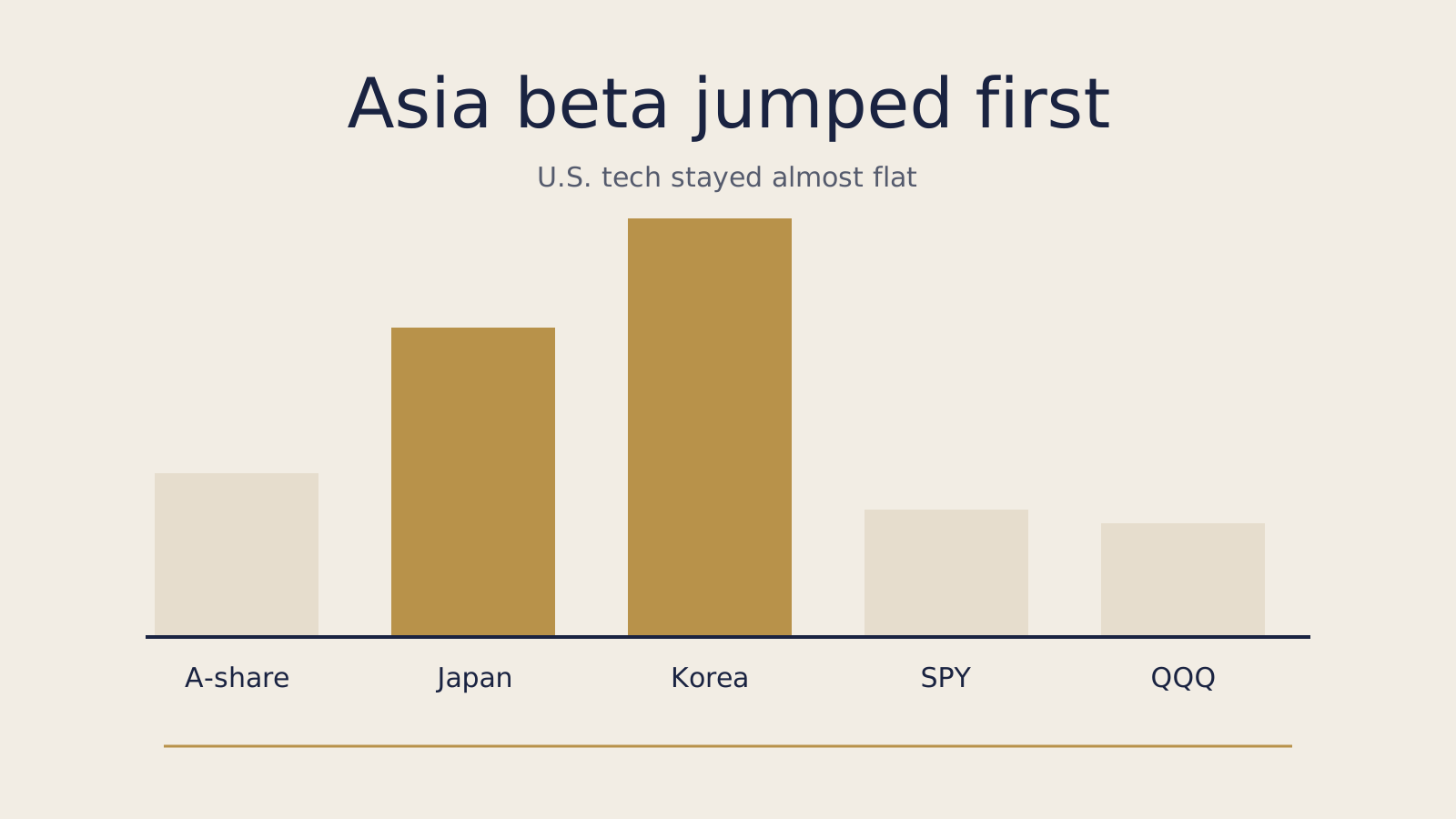
On April 7, Asia’s technology hardware chain released full beta. Nikkei 225 rose 5.39%, Tokyo Electron rose 10.33%; Korea was even stronger, with KOSPI +6.87%, KOSDAQ +5.12%, SK hynix +12.77%, and Samsung Electronics +7.12% (Yahoo Finance daily price data, 2026-04-07).
A-shares repaired too, but more quietly: CSI 300 was roughly flat, CSI 500 rose 0.48%, CSI 1000 rose 0.92%. The U.S. mostly held still: SPY +0.04%, QQQ +0.02%, NVDA +0.26%, TSM +1.04%, ASML +0.19%. VIX rose 6.66% to 25.78.
This was not a synchronized global rally. It was a high-beta repair in the Asian hardware chain. The markets that had fallen hardest bounced hardest; U.S. core tech did not confirm with the same force.
Where the Elasticity Came From
The bounce was strong first because the prior hit had been heavy. On April 1, SK hynix fell 7.47%, Samsung fell 5.93%, and KOSPI fell 4.47%. By April 7, that chain was pulling back a chunk of the risk discount. Tokyo Electron’s 10.33% move fits the same pattern: equipment beta expands when pressure releases.
Second, Asian tech hardware behaves like a risk-temperature gauge. These names are sensitive to AI capex, memory pricing, equipment orders, and export expectations at the same time. When the market shifts from cutting risk to adding risk back, they often move first.
But that is also the problem: high beta is not the same as high confirmation. The U.S. did not show synchronized strength. QQQ barely moved, and VIX rose. Asia traded the bounce; the U.S. had not yet traded full risk clearance.
The Other Side
The lack of U.S. confirmation does not automatically invalidate the Asia move.
Time zones create rhythm gaps. Asia trades first and the U.S. later; one-day non-confirmation is common. Asia may simply have priced warming risk appetite earlier.
High-beta assets often move first. When pressure releases, the most crowded and hardest-hit assets bounce first. That does not make the bounce fake.
VIX rising may reflect lagging hedges. Flat indices with higher volatility can mean investors were still buying protection, but it can also be inertia after a volatile window.
So the April 7 read needs restraint: Asian tech was strong, but the strength was elasticity, not yet cross-market confirmation.
Closing
The combination was clean: Nikkei 225 +5.39%, KOSPI +6.87%, SK hynix +12.77%, Tokyo Electron +10.33%, while SPY and QQQ barely moved and VIX rose.
That says the prior pressure released quickly, especially in Asian semis. It also says global capital had not fully declared the risk event over. Asia bounced first; the U.S. did not confirm. The gap between those two was the thing to watch next.
What to Watch
The following is an observation framework, not a trading signal.
- Whether U.S. tech confirms. If QQQ, NVDA, and TSM follow, the quality of the Asian bounce improves.
- Whether Japan-Korea high beta gives it back. The second day after a sharp rebound matters more than the first.
- Whether VIX retreats from the mid-20s. If volatility stays elevated, the repair still carries defensive color.
Data sources: Asian benchmarks (Nikkei 225, KOSPI, KOSDAQ, plus Japanese and Korean semiconductor names), A-share broad indices (CSI 300 / 500 / 1000), and US large-caps and semiconductors (SPY, QQQ, NVDA, TSM, ASML, VIX) price data from the Yahoo Finance daily price data (Yahoo Finance daily prices and public A-share index quotes), trading day 2026-04-07, queried 2026-05-26.