One Supply Chain, Two Prices
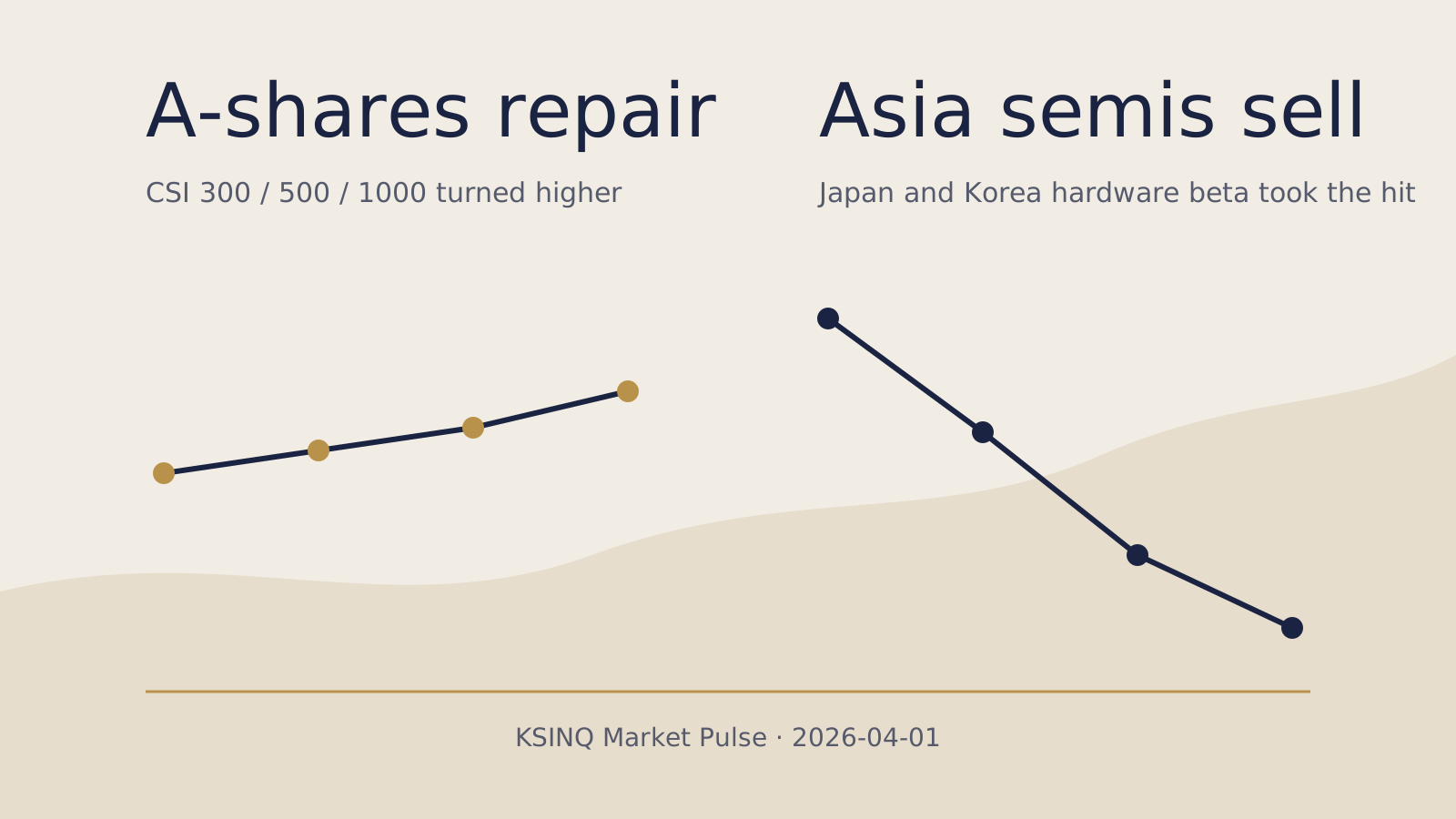
The interesting thing about April 1 was not direction. It was segmentation. In A-shares, broad indices repaired first: CSI 300 closed at 4,526.07, up 1.71%; CSI 500 rose 1.74%; CSI 1000 rose 1.89%. Not an extreme move, but enough to show that mainland risk appetite did not keep sliding.
On the same day, the Japan-Korea semiconductor chain was sold hard. Nikkei 225 fell 2.38%, Tokyo Electron fell 3.21%, and Korea was heavier still: KOSPI -4.47%, KOSDAQ -5.36%, SK hynix -7.47%, Samsung Electronics -5.93% (Yahoo Finance daily price data, trading day 2026-04-01). The U.S. did not confirm the same pressure: QQQ +1.24%, SPY +0.75%, NVDA +0.77%, TSM +1.05%, ASML +2.95%.
That combination says the market was not trading one unified “global tech risk” factor. It was repricing positions inside the supply chain: U.S. core assets still held, A-share broad indices repaired, while Japan-Korea hardware exposure took the valuation cut first.
Why Japan and Korea Moved First
The sensitivity of Japan-Korea semis is that they are not pure AI narrative assets. They sit at the intersection of cycle, exports, and capital expenditure. Tokyo Electron, SK hynix, and Samsung benefit from the AI investment chain, but they also carry equipment orders, memory pricing, FX, and global manufacturing risk.
So when macro uncertainty rises, that chain can become the first place to reduce exposure. NVDA, TSM, and ASML did not fall in sync that day, which means the pressure had not yet become a global consensus. But Japan and Korea had already reflected the fear that hardware exposure was too crowded and too cyclical.
The A-share rise should not be over-read as independent strength either. CSI 300, CSI 500, and CSI 1000 were all up but still within a repair range. Next to the Japan-Korea selloff, the better read is that capital was distinguishing between regions and supply-chain positions: the same “tech and manufacturing” label carried different fragility depending on where it sat.
The Other Side
The day also should not be over-interpreted.
First, one day of divergence is not a structural rotation. The Japan-Korea drawdown may simply have reflected prior gains and crowded positioning, not a turn in the semiconductor cycle.
Second, the A-share rise was not proof of independent strength. The three broad indices rose by less than 2%. That looks more like repair than trend confirmation.
Third, the U.S. tape weakens the global-risk explanation. If this were a full global tech repricing, QQQ, NVDA, TSM, and ASML should have been under pressure too. They were not.
So April 1 is best filed as a sample of position-level differentiation, not a directional verdict.
Closing
The April 1 combination was simple: A-share broad indices repaired, U.S. tech rose modestly, and the Japan-Korea semiconductor chain sold off sharply. The information was not which market was “right.” It was that the same AI / semiconductor chain carried different risk weights in different places.
When a supply-chain trade gets crowded, the market stops asking only whether AI demand still exists. It starts asking which link is closest to the cycle and which link has pricing power. On this day, the pressure landed on Japan-Korea hardware first.
What to Watch
The following is an observation framework, not a trading signal.
- Whether Japan-Korea semis keep underperforming U.S. semis. Persistent weakness would point to compression in Asian hardware-chain premia.
- Whether A-share repair broadens beyond index level. Index repair alone is not enough; breadth and turnover matter next.
- Whether U.S. core tech catches down or stays firm. That decides whether this was local Asian stress or the first leg of a broader tech-risk repricing.
Data sources: A-share broad indices (CSI 300 / 500 / 1000), Asian benchmarks (Nikkei 225, KOSPI, KOSDAQ, plus Japanese and Korean semiconductor names), and US large-caps and semiconductors (SPY, QQQ, NVDA, TSM, ASML) price data from the Yahoo Finance daily price data (Yahoo Finance daily prices and public A-share index quotes), trading day 2026-04-01, queried 2026-05-26.